
Edge AI or Cloud — How to Decide
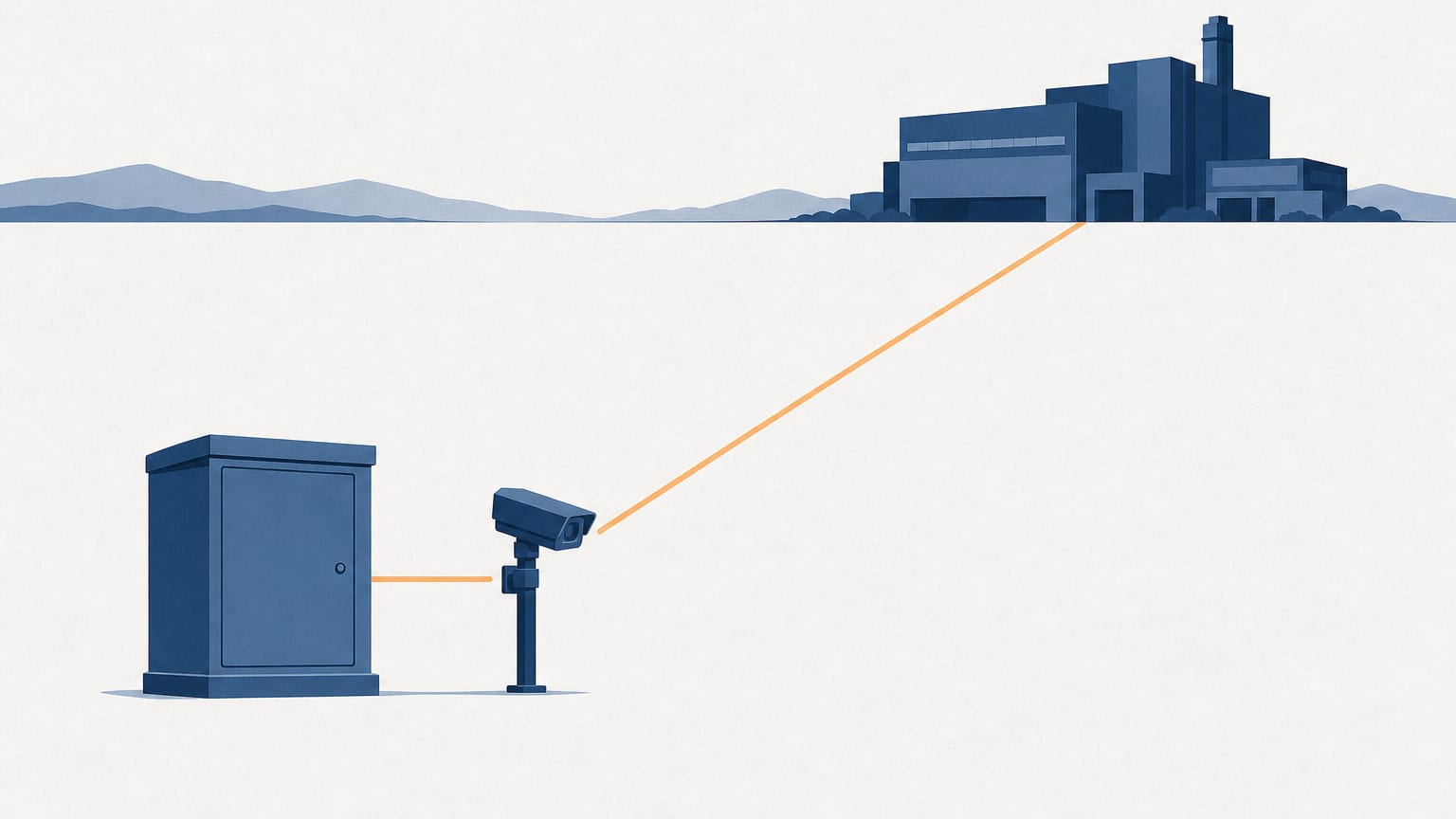
Most edge AI explainers list the same three benefits — low latency, privacy, less bandwidth — and stop there. Reading it does not tell you whether your use case belongs at the edge.
So this is framed as the decision, not the definition. The context is manufacturing, logistics, and airport operations.
The two options
There are broadly two places the processing can happen.
- Cloud — data collected on site is sent over the internet, processed elsewhere, and the result comes back
- Edge — data is processed on the equipment where it was collected, and only the result is used
“Edge” means the end of the network: the site where the data is created. Cameras, sensors, inspection rigs, vehicle-mounted equipment.
Asking which is better is the wrong question. They carry different constraints.
Four axes
1. When is the result needed?
If the result has to stop a line, raise an alarm, or actuate equipment, it belongs at the edge. A network round trip arrives too late to act on.
Daily or monthly aggregation has no such requirement.
2. Can the data leave the site?
Drawings, cost data, customer information, footage with people in it. If contracts or internal policy say it cannot leave, processing has to complete on site.
The practical move here is not to ask whether the data can leave. It is to ask who decides — IT, legal, or a clause in a customer contract. Skip that and the project stops after verification, not before it.
3. Is connectivity reliable?
The back of a plant, a warehouse, outdoors, a moving vehicle. Thin, intermittent, or absent connectivity is ordinary. If the work has to continue while the network is down, that is edge.
4. How much data is there?
Continuously streaming high-resolution video or high-frequency sensor data makes the transfer itself the bottleneck. Extracting only what matters before anything is sent is what solves this.
Side by side
| Consideration | Cloud | Edge |
|---|---|---|
| Time to result | Includes a network round trip | Immediate, on site |
| If the link drops | Stops | Keeps running |
| Where the data sits | Sent outside | Stays on site |
| Processing capacity | Can be scaled up | Bounded by the equipment on site |
| What you plan for | Connectivity, bandwidth, data handling | Site conditions, installation, maintenance |
| Best suited to | Aggregation, analysis, cross-site reporting | Detection, classification, control |
In practice most builds combine the two: detect at the edge, send the result and only the data that matters to the cloud for aggregation. The real design question is not “which one” but “what happens where”.
Where edge fits
In the areas we have worked in:
- Visual inspection — detecting defects and anomalies as they occur, reducing the load of manual inspection
- Predictive maintenance — watching machine condition continuously to catch signs before a failure
- Video analysis on site — processing movement of people and goods locally, so the footage itself never leaves
Each combines the same two conditions: the decision is needed immediately, and the video or equipment data is difficult to send outside.
What gets overlooked
”It worked in the lab” is the failure that matters
The most common breakdown in edge AI is not accuracy. It is that something worked in the test environment and did not survive contact with the site.
Lighting shifts. Objects are placed inconsistently. There is dust and vibration. Exceptions nobody anticipated arrive. A real site is always dirtier than a test rig.
Which is why verification against real data from the actual site belongs at the start, not the end. Numbers produced from clean samples do not transfer. This is also the one thing a remote engagement genuinely depends on: we can run requirements definition, data handover, and verification online, but the data has to be representative of the site as it actually is.
It is not finished when it ships
Sites change. Equipment is replaced, specifications change, conditions shift with the season. Accuracy degrades quietly.
Design edge AI on the assumption this cycle runs continuously, not once.
Whether you can run that loop in-house changes your cost after go-live, not before it. We maintain our own edge AI development platform, Tinyboom, because this repetition is the normal case rather than the exception.
Five questions before you start
- Does the decision have to happen immediately? If it can wait for a batch, cloud is enough.
- Can the data leave the site — and who decides that?
- What is connectivity actually like where the equipment goes?
- Can you release real site data for verification?
- Once it is live, who responds when accuracy drops?
Questions 4 and 5 are the ones most often skipped, and the ones that come back later.
Summary
- Edge AI means the processing happens on the equipment itself. It is not better than cloud — it carries different constraints
- Four axes: when the result is needed / whether data can leave / connectivity / data volume
- Most real builds combine both. The question is not “which” but “what happens where”
- The biggest failure is not accuracy but “it worked in the lab”. Put verification against real site data first
- Design for a continuous loop: collect → label → build → deploy → retrain
If you want to know which side your use case falls on, the site conditions will tell us. We work remote-first — requirements definition, data handover, and verification run online — so a 30-minute consultation is enough to say whether edge or cloud is the realistic answer for your case.
FAQ
Edge or cloud — which should we choose?
It comes down to three things: how fast the result is needed, whether connectivity is reliable, and whether the data can leave the site. A constraint on any one of them puts edge in play. With none of them, cloud is simpler to build and simpler to run.
Does edge AI work without a network connection?
Yes. The processing happens on the equipment itself, so day-to-day operation needs no connectivity. Software updates still require a temporary connection or delivery by physical media.
Can we reuse our existing equipment?
It depends on what you have. During the consultation and the verification stage we separate what can be reused from what has to be added. Starting with a narrow scope on a small configuration is a normal way in.
Can edge and cloud be combined?
Yes, and this is the common outcome. Immediate decisions happen at the edge; accumulated data is analysed and visualised in the cloud. There is no need to force everything to one side.
You are based in Japan. Can you work with us from overseas?
Yes. Requirements definition, data handover, and verification are run remotely by default. What we do need is representative data from your actual site — that is what makes the verification meaningful, and it matters more than physical proximity.